
Many UK Private Medical Insurance (PMI) holders are unknowingly overpaying for prescriptions because they don’t understand the hidden administrative rules of their policy.
- Significant savings are locked behind using an insurer’s ‘preferred pharmacy network’ and getting pre-authorisation before you fill a script.
- Critical cost traps include low outpatient limits that don’t cover post-surgery drugs and automatically accepting branded medications when generics are fully covered.
Recommendation: Proactively review your policy’s pharmacy benefits, specifically the drug formulary and outpatient limits, before you need care to avoid expensive surprises.
If you have private medical insurance in the UK, you likely assume your prescriptions are covered. Yet, many policyholders feel a familiar sting of frustration at the pharmacy counter, paying more than expected or facing outright rejections. You might visit your local independent pharmacy for convenience, pay the full price, and then submit a claim, only to be reimbursed partially or not at all. This cycle of paying and claiming feels cumbersome and often leaves you out of pocket. The common advice— »check your policy » or « ask for generics »—barely scratches the surface of a much more complex system.
The problem isn’t a lack of coverage, but a lack of understanding of the logistical framework that governs prescription benefits. True cost-saving isn’t about shopping around; it’s about mastering the administrative rules your insurer has put in place. These rules involve concepts like preferred pharmacy networks, drug formularies, pre-authorisation codes, and the critical distinction between inpatient and outpatient benefits. Failing to navigate this system correctly is the primary reason for overspending and rejected claims, turning a key policy benefit into a source of financial stress.
But what if the key to saving hundreds of pounds a year wasn’t about finding loopholes, but about simply following the intended path? The truth is that insurers create these networks to control costs, and by aligning with their system, you unlock the maximum savings you are already entitled to. It requires a shift from being a passive patient to a proactive benefits manager of your own health policy.
This guide will demystify that system. We will move beyond generic tips and give you the logistical knowledge to master your policy’s pharmacy benefits. You will learn the specific mechanics of why certain pharmacies are cheaper, how to secure longer-term medication supplies, and what to do when your policy seems to reject a vital prescription. By understanding the ‘why’ behind the rules, you can make your policy work for you, not against you.
This article provides a detailed breakdown of the strategies that can significantly reduce your prescription costs. The following summary outlines the key areas we will explore to help you navigate your policy effectively and unlock substantial savings.
Summary: A Guide to Your Insurer’s Pharmacy Network
- Why Does Filling Prescriptions at Boots Cost Less Under Certain Health Policies?
- How to Get 90-Day Supplies Delivered Home and Cut Your Prescription Costs by 25%?
- Group Scheme vs Individual Policy: Which Offers Better Pharmacy Discounts?
- The £80 Mistake: Paying for Branded Drugs When Generics Are Covered at 100%
- When Should You Review Pharmacy Benefits: During Renewal or After a New Diagnosis?
- The Expensive Surprise: Why Your Insurer Covers Surgery but Not the Follow-Up Drugs
- How to Add Preventive Care Riders to Your Policy for Under £30 Per Month?
- Why Does Your Private Health Policy Reject 40% of Prescribed Medications?
Why Does Filling Prescriptions at Boots Cost Less Under Certain Health Policies?
The reason filling a prescription at a large chain like Boots can be significantly cheaper under your PMI policy has little to do with the pharmacy’s retail prices and everything to do with pre-negotiated agreements. Major insurers like Bupa and AXA establish preferred pharmacy networks. They negotiate discounted rates on medications and streamlined billing processes with these select partners. When you use an in-network pharmacy, you are accessing these preferential terms. Conversely, using an out-of-network independent pharmacy means you pay the full retail price and navigate a clunky reimbursement process that often results in a shortfall.
The key mechanism that unlocks these savings is direct billing, which is only possible with a pre-authorisation code from your insurer. Before visiting the pharmacy, you must contact your insurer, provide details of your prescription, and receive this code. At a network pharmacy like Boots, the pharmacist enters this code into their system. This instantly verifies your coverage, applies the insurer’s negotiated rate, and bills the insurer directly. You are left to pay only your fixed copay or excess, if any. This process eliminates the need for you to pay the full cost upfront.
Without a pre-authorisation code, even an in-network pharmacy cannot process the direct billing, forcing you into the less favourable ‘pay and claim’ cycle. Many policyholders are unaware of this crucial first step, leading them to pay more than necessary. Mastering this simple administrative process is the first and most critical step in controlling your prescription costs.
- Step 1: Contact your insurer (Bupa, AXA, etc.) and request a pre-authorisation code for your specific prescription before visiting the pharmacy.
- Step 2: Verify that your chosen Boots location is in your insurer’s preferred network by checking your policy documents or calling the insurer’s pharmacy helpline.
- Step 3: Present your insurance card and pre-authorisation code to the Boots pharmacist at the time of prescription drop-off.
- Step 4: The pharmacist enters the code into their system, which automatically applies the negotiated in-network rate and processes direct billing to your insurer.
- Step 5: Pay only your copay amount at collection, avoiding the full price upfront and the cumbersome ‘pay and claim’ reimbursement process.
How to Get 90-Day Supplies Delivered Home and Cut Your Prescription Costs by 25%?
For individuals managing chronic conditions like hypertension or diabetes, a 30-day prescription cycle creates unnecessary administrative burdens and repeat visits to the GP and pharmacy. A more efficient and cost-effective approach is securing a 90-day supply of your maintenance medication. This not only reduces your logistical hassle but can also lower your per-dose cost, as insurers often incentivise bulk prescriptions to improve medication adherence and reduce processing fees. However, many GPs default to 30-day scripts, so you must proactively request this change.
To successfully request a 90-day supply, you need to present a clear rationale to your GP. Explain that the medication is for a stable, long-term condition and that a three-month supply will improve your adherence to the treatment plan. It is crucial to confirm with your insurer beforehand that your policy and the specific drug are eligible for 90-day coverage. Approaching your GP with this information demonstrates you have done your homework and understand the requirements, making them more likely to approve your request.
Once you have your 90-day prescription, you can leverage digital pharmacies for home delivery. Services like Pharmacy2U and LloydsDirect partner with the NHS and private insurers to offer convenient, tracked delivery, often at no extra cost. This is especially useful for temperature-sensitive medications, as these services use specialised packaging to ensure drug integrity. Using a digital pharmacy for your 90-day supply streamlines your entire medication management process, saving you time, travel, and money.
Once you have a 90-day prescription, choosing the right delivery service is the next step. UK digital pharmacies offer different speeds and features, so it’s wise to compare them.
| Digital Pharmacy | Delivery Service | Typical Delivery Time | Refrigerated Medication Handling | App Usability |
|---|---|---|---|---|
| Pharmacy2U | Royal Mail Tracked 24/48hr | Within 48 hours from dispatch | Tracked 24 in special packaging | Order tracking, reminder notifications via email/SMS/app |
| LloydsDirect (Well Pharmacy) | Standard delivery service | 3-5 working days | Temperature-controlled packaging available | Basic order management |
| Chemist4U | Free NHS prescription delivery | Standard delivery timeframe | Specialist packaging for temperature-sensitive items | Mobile app for repeat prescriptions with reminders |
Group Scheme vs Individual Policy: Which Offers Better Pharmacy Discounts?
The type of PMI policy you hold—a company group scheme or a private individual plan—has a significant impact on your pharmacy benefits. While both can offer savings, they do so in different ways. Group policies, purchased by a company for its employees, benefit from collective bargaining power. Insurance brokers negotiating on behalf of hundreds or thousands of employees can secure deeper, more targeted discounts. This is often achieved by creating a more restrictive drug formulary—a specific list of covered medications—that prioritises cost-effective options.
This means that if your medication is on the group formulary, you are likely to get it at a very low cost. However, the downside is inflexibility. If your specialist prescribes a newer, more expensive drug that is not on the list, getting it covered can be extremely difficult. Group schemes are designed for the needs of the many, not the specific requirements of the few. According to insights from UK insurance experts, group policies often leverage the collective purchasing power to negotiate discounted rates, but this comes at the cost of a rigid formulary.
In contrast, individual policies, especially premium-tier plans, often provide greater flexibility. While the upfront premiums are higher, these policies may offer a broader formulary or a more straightforward process for requesting exceptions for off-formulary drugs based on medical necessity. The trade-off is clear: group schemes offer guaranteed savings on a limited set of drugs, while individual policies offer potentially wider access to medications at a higher overall cost. To get the best value, you must obtain your specific group scheme’s formulary from your HR department, not the insurer’s generic helpline, to see if your needs align with its cost-saving structure.
Case Study: Group Scheme Negotiated Formulary Advantages
Group Private Medical Insurance schemes allow large companies’ brokers to negotiate customized formularies with deeper discounts. For example, a company with 500 employees can leverage collective bargaining to secure preferential pricing on commonly needed medications. However, these schemes often have more rigid formularies, meaning less flexibility for off-formulary drugs. Individual policyholders on premium plans may have more flexibility to request exceptions for specialized medications, albeit at higher premiums, representing a trade-off between guaranteed savings and potential access to a broader range of treatments.
The £80 Mistake: Paying for Branded Drugs When Generics Are Covered at 100%
One of the most common and costly mistakes a PMI policyholder can make is paying for a branded medication when a chemically identical generic version is available and fully covered. Insurers build their formularies around generic drugs because they are significantly cheaper. When your consultant writes a prescription for a branded drug like Lipitor, your insurer’s system will automatically flag it and either reject the claim or apply a high copay, assuming a generic alternative (Atorvastatin) exists. This can result in you paying an £80 out-of-pocket cost for the brand, when the generic would have cost you nothing.
Pharmacists are often obligated to dispense the exact drug prescribed. Therefore, the responsibility falls on you and your consultant to be proactive. Always ask your specialist if a generic alternative is appropriate for your condition. In most cases, the active ingredient is identical, and the therapeutic effect is the same. By requesting the prescription be written for the generic name, you align with your insurer’s cost-saving protocols from the outset and avoid claim rejections.
However, there are rare situations where a branded drug is clinically necessary. A patient might have an allergic reaction to an inactive ingredient (a binder or dye) in the generic version. In this scenario, you can’t simply pay for the brand and hope for reimbursement. You must follow a formal process to request a medical necessity exception. This involves your consultant writing a detailed letter to the insurer explaining the clinical reasons why the generic is unsuitable. This formal justification is the only way to compel an insurer to cover a more expensive branded drug at the lower, in-network rate.
The choice between generic and branded medication is a key decision point in managing prescription costs. Visually, the options may seem similar, but their impact on your wallet is vastly different.
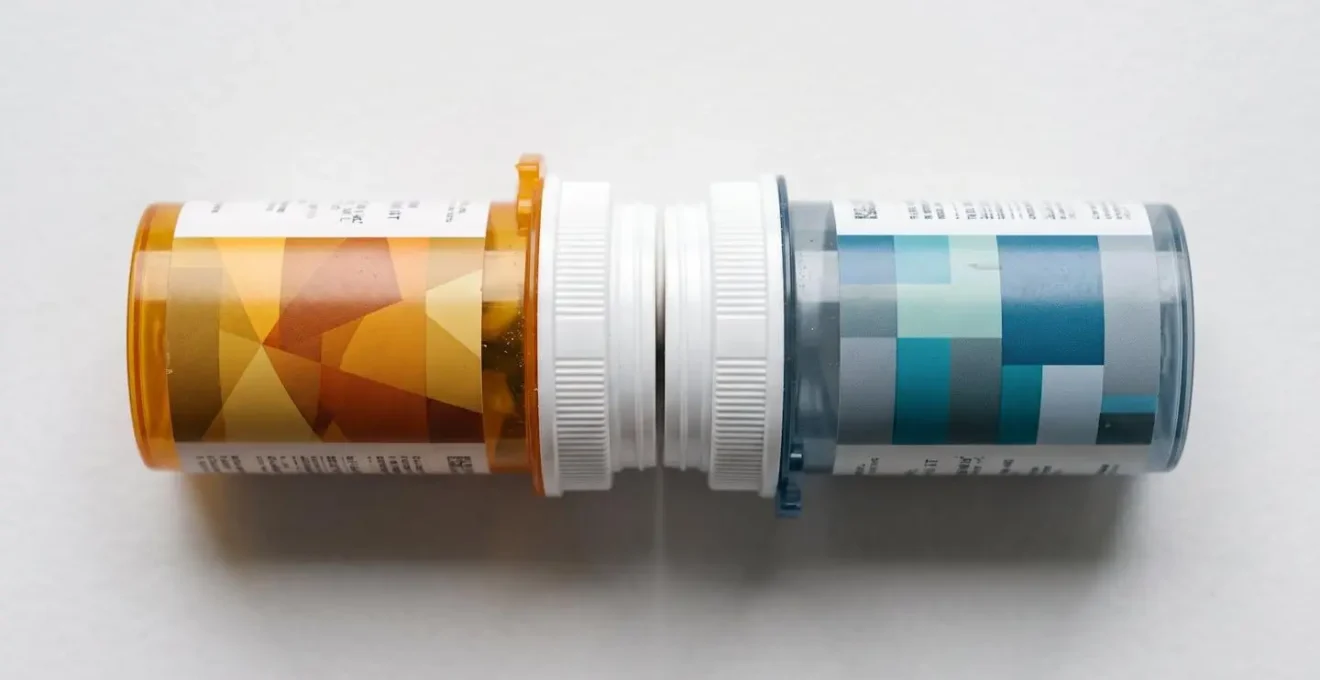
As the image suggests, the choice is not always straightforward. While the bottles may look different, the essential medicine inside is often the same. Making the financially smart choice requires understanding your policy’s rules. If a branded drug is truly necessary, you must follow the correct procedure to get it covered.
- Step 1: Request a formal letter from your consultant detailing ‘medical necessity’ for the branded drug.
- Step 2: Document any previous adverse reactions or allergic responses to inactive ingredients in the generic formulation.
- Step 3: Submit the consultant’s letter along with a prior authorization request form to your insurer’s medical review department.
- Step 4: Include supporting clinical evidence such as pharmacy records showing previous generic trial and failure.
- Step 5: Follow up within 5-7 business days and request escalation to a senior medical reviewer if initially denied.
When Should You Review Pharmacy Benefits: During Renewal or After a New Diagnosis?
Many policyholders only review their health insurance documents once a year at renewal time. While this is important, it is not the most critical moment to scrutinise your pharmacy benefits. The single most important time to review your policy is immediately after receiving a new diagnosis, especially for a chronic condition that will require long-term medication. This is the moment when your theoretical coverage becomes a practical reality, and any gaps in your policy will become apparent.
Insurers can and do change their drug formularies and pharmacy networks annually, a fact that major health insurers warn about in their policy documents. A medication that was covered last year might be moved to a higher copay tier or removed entirely this year. Therefore, after a new diagnosis, you must immediately contact your insurer with a list of specific, critical questions. Do not simply ask « is my new drug covered? » You need to ask about its formulary tier, the expected out-of-pocket cost per fill, its eligibility for a 90-day supply, and whether any prior authorisation is needed. This proactive inquiry prevents you from showing up at the pharmacy only to be hit with an unexpected high cost.
This review is also your opportunity to align your choice of specialist and treatment plan with your policy’s strengths. If your policy has a strong network and low copays for generics, you can discuss this with your consultant. Being an informed patient allows you to partner with your doctor to choose a treatment path that is both clinically effective and financially sustainable under your specific PMI plan. Waiting until renewal is a reactive approach; a post-diagnosis review is a proactive strategy to manage future costs.
After a new chronic diagnosis, asking your insurer the right questions is vital. Here are the key points to cover:
- Question 1: ‘Is [Drug Name] on my current formulary, and what tier/copay level is it classified under?’
- Question 2: ‘What is my expected out-of-pocket cost per prescription fill, including any deductibles or coinsurance that apply?’
- Question 3: ‘Is this medication available via a 90-day supply option, and would that reduce my per-dose cost?’
- Question 4: ‘Which pharmacies in your preferred network offer the lowest copay for this specific medication?’
- Question 5: ‘Are there any prior authorization requirements or step therapy protocols I need to complete before coverage begins?’
- Question 6: ‘Does this medication count toward my annual outpatient coverage limit, and if so, how much of that limit does each prescription consume?’
The Expensive Surprise: Why Your Insurer Covers Surgery but Not the Follow-Up Drugs
One of the most jarring experiences for a PMI policyholder is having a major surgical procedure, like a knee replacement, fully covered, only to find that the essential post-operative medications are rejected. This happens due to a critical and often misunderstood feature of UK health policies: the separation of inpatient and outpatient benefits, each with its own coverage limit. Your surgery is covered under your inpatient benefits, which typically have a high or unlimited cap. However, the take-home drugs you need for recovery—painkillers, anti-inflammatories, antibiotics—are processed under your outpatient limit.
Many standard policies have a low annual outpatient limit, often between £500 and £1,000. This limit is shared across all outpatient services, including specialist consultations, diagnostic scans (like MRIs), and prescriptions. Before your surgery, you likely used a portion of this limit for consultations and scans. The cost of your post-operative medications can quickly exhaust the remaining balance, leaving you to pay the rest entirely out-of-pocket. This « expensive surprise » is a direct result of the administrative partitioning of benefits.
To avoid this, you must be exceptionally proactive before any planned surgery. When you obtain pre-authorisation for the procedure, you must explicitly ask your insurer to confirm, in writing, how the post-operative take-home medications will be covered. Request a separate authorisation code for the drugs and an itemised breakdown of how they will be counted against your inpatient versus outpatient limits. This forces clarity on the issue and allows you to budget accordingly or discuss alternative, covered medications with your surgeon before the procedure.
Case Study: Outpatient Cover Limit Exhaustion
A policyholder undergoes a successful private knee replacement, fully covered under inpatient benefits. However, the post-operative take-home medications are categorised as outpatient prescriptions. As the patient had already used £600 of their £1,000 annual outpatient limit on pre-surgery consultations and scans, the follow-up drugs quickly exhaust the remaining £400 limit, leaving the patient to pay the balance out-of-pocket. This common scenario, highlighted in analyses of the UK healthcare reimbursement system, is a blind spot that catches many by surprise.
How to Add Preventive Care Riders to Your Policy for Under £30 Per Month?
Traditional health insurance is reactive; it pays for treatment when you get sick. A more modern approach, however, involves preventive care, and some insurers allow you to add ‘wellness’ or ‘preventive care’ riders to your policy for a modest monthly fee, often under £30. These riders are designed to keep you healthy, which in turn saves the insurer money on expensive future treatments. This represents a fundamental shift from a model of sickness management to one of health promotion.
Insurers like Vitality have built their entire business model around this principle. They incentivise healthy behaviours through rewards programs linked to wearable tech. By tracking physical activity, completing health assessments, and meeting fitness goals, policyholders can earn tangible rewards like discounted gym memberships and even pharmacy-related perks. The underlying logic is simple: it is far more cost-effective for an insurer to help fund a £10/month statin prescription to prevent a heart attack than it is to pay for a major cardiac surgery, which according to UK private healthcare pricing data, can cost tens of thousands of pounds.
Adding a preventive care rider can be a smart financial move if you are committed to maintaining your health. When reviewing your policy, ask your insurer or broker about the availability and cost of such add-ons. They often provide benefits for routine check-ups, screenings, and sometimes even cover a portion of preventive medications that a standard policy might not. Investing a small amount each month in a wellness rider can yield significant returns, both for your long-term health and your financial well-being, by stopping major health issues before they start.
Case Study: Vitality’s Preventive Care Model
Vitality Health Insurance actively incentivizes preventive health actions. Policyholders can link wearable devices to track activity and complete health goals. These activities unlock rewards, including up to 50% off at major gyms and pharmacy-related perks. The insurer’s model is based on ROI: preventing a heart attack with a low-cost preventive prescription is far more cost-effective than paying for a £20,000 bypass surgery. This approach benefits both the policyholder’s health and the insurer’s long-term financial sustainability.
Key Takeaways
- Your policy’s savings are unlocked by using the insurer’s ‘preferred pharmacy network’ and getting a ‘pre-authorisation code’ before you fill a script.
- Be aware of your ‘outpatient limit’ as it is often low and covers post-surgery take-home drugs, leading to unexpected costs.
- Always request generic drugs and only pursue branded options through a formal ‘medical necessity’ appeal to avoid high out-of-pocket expenses.
Why Does Your Private Health Policy Reject 40% of Prescribed Medications?
It can be deeply unsettling when your private health policy, which you pay for diligently, rejects a medication prescribed by your specialist. The reasons for these rejections are rarely arbitrary and usually fall into a few key categories. The most common reason is a formulary exclusion. Your policy’s formulary is the definitive list of drugs it will cover. If a prescribed medication is not on that list—often because it is a new, expensive branded drug with a cheaper generic alternative available—it will be automatically rejected.
Another major factor is the influence of the National Institute for Health and Care Excellence (NICE). While NICE guidelines primarily determine which drugs the NHS will fund, private insurers watch them closely. As regulatory authorities confirm that guidelines issued by NICE play an important role in clinical practice, if NICE has not approved a drug for use due to its cost-effectiveness, a private insurer is highly likely to follow suit and refuse coverage. Other reasons for rejection include a failure to obtain prior authorisation or prescribing a drug for a condition that is listed as a general exclusion on your policy (e.g., chronic conditions on some basic plans).
However, an initial rejection is not the end of the road. You have the right to appeal the decision, but a successful appeal requires a structured, evidence-based approach. A simple letter of complaint will be dismissed. You must build a formal case, typically including a detailed letter from your consultant justifying medical necessity, evidence of failure or intolerance to formulary alternatives, and citations of clinical data that support the use of the prescribed drug for your specific condition. This transforms your request from a simple complaint into a robust clinical argument that the insurer’s medical review board must seriously consider.
Your Action Plan: Template for a Successful Medication Appeal
- Gather Medical Necessity Evidence: Obtain a detailed letter from your consultant explaining exactly why the prescribed medication is medically necessary for your specific condition, referencing clinical guidelines and your individual health circumstances.
- Document Alternative Failures: Collect pharmacy records and notes detailing any previous trials of generic or formulary alternatives that failed or caused intolerance, including dates and specific adverse reactions.
- Cite Your Policy: Scour your policy document and reference specific clauses that support your claim, such as coverage for ‘medically necessary treatments’ or exceptions for ‘documented clinical need.’
- Provide Clinical Proof: Attach relevant NICE guidance, peer-reviewed studies, or recommendations from specialist societies that support the use of the prescribed medication for your diagnosis.
- State the Impact: Clearly describe the functional impact on your quality of life or ability to work if the medication is not covered, focusing on acute (treatable) aspects of your condition.
To truly take control of your prescription costs, the next logical step is to apply this knowledge. Review your current policy documents—specifically the drug formulary, outpatient limits, and list of preferred pharmacies—and have a proactive conversation with your insurer or broker today.