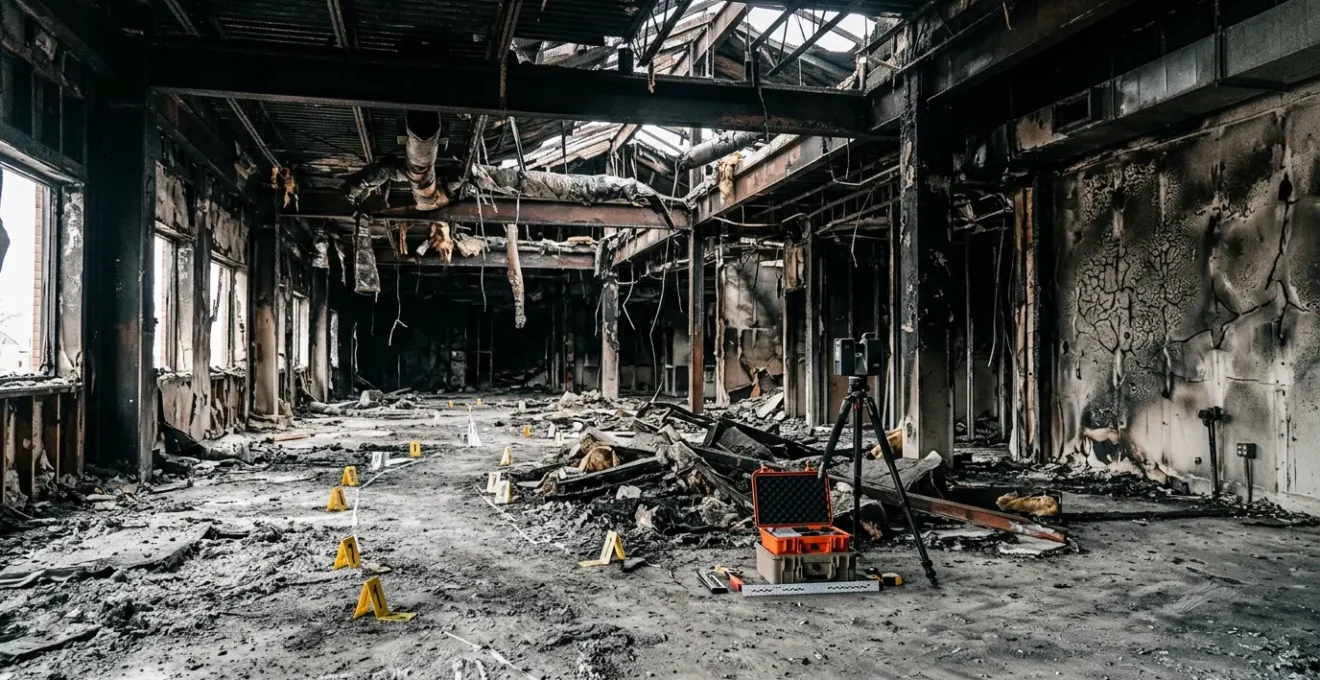
Successfully proving a large fire claim isn’t about collecting disparate reports; it’s about constructing a single, unified forensic narrative that makes your loss objective and undeniable.
- The insurer’s experts are there to challenge your claim; your own multi-disciplinary team is there to build a case that pre-empts those challenges.
- Evidence integrity is paramount. The actions taken in the first 48 hours to preserve the scene can determine the success or failure of a multi-hundred-thousand-pound claim.
Recommendation: Immediately engage your own independent experts—starting with a fire investigator—before any cleanup or alteration of the scene, even before the insurer’s loss adjuster has completed their initial visit.
When a fire strikes your business, the initial shock is quickly replaced by the daunting task of recovery. For a claim around the £200,000 mark, you enter a perilous zone. The loss is significant enough to trigger intense scrutiny from your insurer, yet it might not seem large enough to immediately justify assembling a full legal and expert team. This is a critical miscalculation. Insurers will appoint their own loss adjusters and forensic experts whose primary role is to mitigate the insurer’s exposure. They will scrutinise every detail, from the fire’s origin to the valuation of your lost profits.
The common advice is to « document everything » and « cooperate with the adjuster. » While true, this passive approach is insufficient for a claim of this magnitude. The key to navigating this adversarial process is not merely to respond to the insurer’s queries, but to proactively build your own unassailable case. This requires a fundamental shift in mindset: you are not just filing a claim; you are constructing a forensic narrative.
This means assembling your own team of independent experts—a fire investigator, a structural engineer, a forensic accountant—who work in concert. Their goal is to weave together a single, coherent story from physical and financial evidence, creating an evidence interlock that leaves no room for doubt or dispute. This guide will deconstruct how to build that narrative, transforming your subjective loss into an objective, evidence-backed reality that your insurer cannot ignore.
This article details the strategic use of forensic experts to substantiate a complex fire claim. Below, the table of contents outlines the key stages, from understanding the roles of different investigators to proving your financial losses.
Summary: Using Forensic Evidence for a Major Fire Claim
- Why Does Your Insurer Require an Independent Fire Investigator for Large Claims?
- Fire Investigator vs Structural Engineer: Which Expert Does Your Collapse Claim Need?
- Can You Appoint Your Own Forensic Accountant to Challenge the Insurer’s Loss Assessment?
- The Contaminated Fire Scene That Undermined a £500,000 Claim
- When Should You Call a Forensic Expert: Within Hours or After the Adjuster Visits?
- Why Does a Multi-Disciplinary Team Catch Diagnoses That Single Consultants Miss?
- Should You Appoint Your Own Forensic Accountant to Challenge the Adjuster’s Figures?
- How to Prove a £200,000 Loss of Profit Claim to Your Insurer?
Why Does Your Insurer Require an Independent Fire Investigator for Large Claims?
When your claim surpasses a certain threshold, often around £100,000, your insurer’s response protocol changes dramatically. The file is no longer a simple administrative matter for a desk-based adjuster; it becomes a case requiring technical validation. The insurer will appoint an independent fire investigator not as a formality, but as a crucial risk management tool. Their primary objective is to determine the fire’s origin and cause (O&C) with scientific certainty, following methodologies like NFPA 921 (Guide for Fire and Explosion Investigations).
This investigation serves several purposes for the insurer. Firstly, it seeks to rule out policy exclusions such as arson or deliberate acts. Insurers are acutely aware of fraudulent activities, which are a significant industry issue. Secondly, the investigator’s findings are critical for subrogation potential. If they can prove that a faulty piece of equipment or a third party’s negligence caused the fire, the insurer can pursue that party to recover their payout. Finally, the expert report provides an objective basis to challenge the quantum of the claim if the damage described seems inconsistent with the fire’s behaviour.
The investigator they appoint is ‘independent’ in that they are an external consultant, but their duty is to their client: the insurer. Their brief is to provide an impartial, factual report, but their focus will naturally align with the insurer’s interests—identifying factors that might limit the claim’s scope or validity. This is precisely why you, the policyholder, cannot rely solely on their findings. Understanding that the insurer’s investigation is a defensive measure is the first step in building your own offensive strategy.
Fire Investigator vs Structural Engineer: Which Expert Does Your Collapse Claim Need?
In the aftermath of a significant fire, especially one involving structural collapse or distortion, a common point of confusion arises: do you need a fire investigator or a structural engineer? The answer is almost always both. These experts investigate different facets of the same event, and their findings must interlock to form a complete forensic narrative. Attempting to use one to do the job of the other is a frequent and costly mistake.
A Certified Fire Investigator (CFI) focuses on the fire’s journey. Their expertise lies in reading burn patterns, analysing fire dynamics, and identifying the ignition source. They answer the question: « How and where did the fire start, and how did it spread? » They establish the initial chain of causation. A Forensic Structural Engineer, on the other hand, analyses the building’s response to the fire. They answer the question: « How did the heat, smoke, and suppression efforts affect the building’s materials and systems? »
This paragraph introduces the complex analysis of fire-damaged structures. The illustration below highlights the kind of material failure patterns that a forensic engineer would scrutinise.
As this image of a heat-distorted steel beam shows, the engineer evaluates material strength, ductility, and signs of failure. They can differentiate between damage caused by the fire and pre-existing structural defects—a critical distinction that insurers often use to reduce a claim. For example, the fire investigator might determine the fire started in an electrical panel, but the structural engineer might prove that the subsequent roof collapse was due to the extreme heat compromising specific steel trusses, not poor construction. According to Envista Forensics, complex investigations require fire investigators working in concert with engineers and other consultants to establish these comprehensive causal chains, especially in large-scale claims.
Can You Appoint Your Own Forensic Accountant to Challenge the Insurer’s Loss Assessment?
Yes, and for a claim of £200,000 involving business interruption, it is not just possible—it is essential. While the loss adjuster appointed by the insurer may have accounting skills, their role is to adjust the claim, often downwards, based on their interpretation of your policy and financials. They are not your advocate. Appointing your own forensic accountant shifts the dynamic from reactive defence to proactive offence. Your expert’s role is to build your loss of profit claim from the ground up, based on a rigorous, evidence-based « but-for » analysis.
This involves projecting what the business’s financial performance *would have been* but for the fire. This is far more complex than simply looking at last year’s profits. A skilled forensic accountant will analyse historical trends, market conditions, seasonality, and pre-loss business plans or forecasts to create a defensible model of lost income. They will also meticulously quantify continuing operating expenses that you are entitled to claim during the period of restoration. Insurers are on high alert for inflated claims, especially given the scale of potential fraud, which costs the industry billions. An independent report adds immense credibility.
Your forensic accountant acts as your financial translator and strategist, ensuring the data presented to the insurer is clear, logical, and irrefutable. They prepare a detailed report that not only substantiates your £200,000 figure but also pre-empts the adjuster’s likely challenges. This pre-emptive quantification puts the onus on the insurer to disprove your carefully calculated claim, rather than forcing you to fight against their initial lowball offer.
Your Action Plan: Assembling Documents for Your Forensic Accountant
- Policy & Timeline Review: Collate your full business interruption policy, noting the period of restoration and coverage limits, alongside all notification letters to the insurer and reports from remediation contractors to establish a clear timeline.
- Gather Historical Financials: Collect 2-3 years of complete profit and loss statements, balance sheets, and company tax returns to establish a credible performance baseline.
- Compile Performance Data: Inventory your monthly sales summaries and detailed cost-of-goods-sold reports. This data is crucial for performing accurate trend analysis.
- Secure Future Projections: Locate business forecasts, operational budgets, and board meeting minutes that contain or discuss financial projections. These documents help build the « but-for » loss scenario.
- Verify Restoration Period: Gather all communications and documents that officially define the start and end of the business interruption period, as this is a frequent point of contention.
The Contaminated Fire Scene That Undermined a £500,000 Claim
The integrity of the fire scene is the foundation upon which your entire claim is built. Once that integrity is compromised, even the best experts will struggle to build a conclusive case. This principle is known in legal and forensic circles as evidence preservation, and its violation is called spoliation of evidence. It occurs when evidence is altered, lost, or destroyed, whether intentionally or accidentally. For a business owner eager to clean up and restart, this presents a huge risk. A premature cleanup can permanently erase the subtle clues a fire investigator needs to determine the origin and cause.
Imagine a scenario: a fire occurs in a workshop. The owner, wanting to show proactive recovery efforts, has a team clear debris and remove damaged machinery before the forensic investigator arrives. In doing so, they may have moved the very component that failed and caused the fire, or swept away the delicate char patterns that indicated the fire’s point of origin. The scene is now contaminated. When the insurer’s expert arrives, they can only conclude that the origin is « undetermined » due to scene disturbance. This ambiguity gives the insurer powerful leverage to dispute or deny the claim, arguing that a policy exclusion (like an intentional act) cannot be ruled out.
As George A. Codding, a State Fraud Prosecutor, warns in Fire Engineering, the consequences can be severe. He states: « Spoliation of evidence occurs when persons or entities unnecessarily alter, lose, or destroy evidence they had the duty to protect. A finding of spoliation can result in sanctions against a party in court or even legal liability in extreme cases. » Your duty as the property owner is to secure the scene immediately. This means restricting access, preventing any form of cleaning or debris removal, and protecting the area from the elements until your own experts and the insurer’s have conducted their examinations.
When Should You Call a Forensic Expert: Within Hours or After the Adjuster Visits?
The correct answer is unequivocally: within hours. The single biggest mistake a business owner can make after a fire is to wait. Waiting for the insurance adjuster to visit, waiting for the insurer to grant « permission, » or waiting to « see what they offer » cedes control of the most critical phase of the claim: the evidence preservation window. The first 24 to 72 hours are decisive.
Fire scenes are incredibly fragile. Evidence degrades rapidly from exposure to air, moisture, and suppression agents like water and foam. More pressingly, restoration contractors are often on-site, eager to begin demolition and cleanup. Their job is to remediate the property, not to preserve evidence. As expert James Laird, PE, IAAI-CFI, advises, the call must be immediate: « For fire investigations: immediately — within 24 hours if possible. Fire scenes degrade rapidly, and in active insurance claims, restoration contractors are often pushing to begin work as soon as the structure is cleared. » Engaging your own investigator immediately ensures someone is on-site with the sole purpose of protecting your interests by preserving crucial evidence.
A case study highlighted by CAE Forensic illustrates the danger of delay. In many claims they reviewed, by the time the carrier authorised an investigation, the property had already been partially remediated. The investigator was faced with a degraded scene, missing components, and had to rely on photographs taken by non-engineers as the only record of the original conditions. This forced the case into a battle of dueling speculations between experts, a situation that always benefits the insurer. By engaging your expert immediately, you take control of the scene, ensure all evidence is documented to a forensic standard, and begin building your forensic narrative before it can be compromised.
Why Does a Multi-Disciplinary Team Catch Diagnoses That Single Consultants Miss?
In a complex fire claim, relying on a single expert, no matter how skilled, is like trying to solve a puzzle with only a third of the pieces. A fire’s impact is never one-dimensional. It is a cascade of events involving combustion, structural stress, business interruption, and potential contamination. Proving your claim requires a holistic diagnosis that connects all these dots into a single, coherent causation chain. This can only be achieved by a multi-disciplinary team whose findings interlock and reinforce one another.
A single consultant operates in a silo. A fire investigator can pinpoint the origin, but they cannot quantify the lost profit. A structural engineer can assess beam integrity, but they cannot value the cost of business interruption during repairs. As highlighted by experts at Envista Forensics, a major fire loss often demands a team approach where, for instance, « a fire loss may require a fire investigator, an electrical engineer, a construction consultant, a digital forensics expert, and a cost analyst—all working in concert. » This « evidence interlock » is what builds an unshakeable claim.
Consider this: the fire investigator determines the fire started from an overheated motor in a CNC machine. The forensic accountant uses the machine’s logs (if recoverable) and production schedules to precisely quantify the lost output. The structural engineer assesses the heat damage to the concrete slab beneath the machine, providing a defensible basis for its necessary replacement rather than a simple repair. Each expert’s report, on its own, is a single data point. Together, they form a forensic narrative that proves not only the cause of the fire but also the full, cascading financial consequences, leaving the insurer with no credible angle to dispute the claim’s validity or quantum.
Should You Appoint Your Own Forensic Accountant to Challenge the Adjuster’s Figures?
Absolutely. The insurer’s loss adjuster and their appointed forensic accountant are tasked with interpreting your policy in the light most favourable to the insurer. They will often make assumptions—about market trends, saved expenses, or the speed of recovery—that inherently minimise the payout. To challenge their figures effectively, you must present an alternative calculation that is not just a different opinion, but a more rigorously evidenced one. This is the precise role of your own forensic accountant.
Their first job is to deconstruct the adjuster’s calculations. They will scrutinise every assumption. Did the adjuster incorrectly apply a market downturn to your industry when your specific niche was growing? Did they overestimate the « saved expenses » from not operating, ignoring fixed costs you still had to pay? Your expert will then build your case, using your company’s specific data to refute these assumptions. This process is standard for significant claims, with some forensic accounting firms reviewing business interruption claims ranging from thousands of dollars to claims exceeding $100 million+.
Case Study: Challenging the Narrative with Data
In a documented case, a convenience store filed a major business interruption claim after a fire. The business was closed for a full year. The insurer’s adjuster proposed a settlement based on the previous year’s performance. However, the policyholder’s forensic accountant analysed the store’s historic growth trajectory, local demographic shifts, and pre-fire plans for a new, high-margin product line. By building a detailed ‘but-for’ model incorporating these factors, they proved the adjuster’s figure was based on an artificially low baseline. The forensic accountant’s report methodically demonstrated a much higher projected revenue, forcing the insurer to significantly increase their offer by challenging the fundamental assumptions of their initial calculation.
Your accountant doesn’t just check the math; they challenge the story behind the numbers. By presenting a detailed, evidence-backed counter-narrative, they transform the negotiation from an argument over opinion to a discussion based on verifiable facts, giving you the leverage to secure the full settlement you are owed.
Key takeaways
- A claim’s success hinges on a pro-active, unified forensic narrative, not a passive collection of documents.
- Evidence is fragile. The first 48 hours are critical for preserving the fire scene under expert guidance to prevent spoliation.
- A multi-disciplinary team (fire investigator, engineer, accountant) creates an « evidence interlock » that is far more powerful than separate, siloed reports.
How to Prove a £200,000 Loss of Profit Claim to Your Insurer?
Proving a £200,000 loss of profit claim is the culmination of the entire forensic process. It’s where the physical evidence established by investigators and engineers merges with the financial analysis of your forensic accountant. The goal is to present a business interruption (BI) claim that is so thoroughly documented and logically constructed that it becomes the undisputed basis for settlement. The core principle, as the VERTEX Forensic Accounting Team states, is that « BI insurance is designed only to restore the insured back to where it would have been financially, had business continued as normal. » Your task is to prove, with data, exactly what « normal » would have looked like.
The first step is establishing the Period of Restoration. This is the timeframe from the date of the fire until your business can resume normal operations at the pre-loss level. This period is often a major point of dispute and must be substantiated with reports from contractors, equipment lead time documentation, and other evidence gathered by your team.
Next, your forensic accountant will construct the « but-for » revenue model. Using your historical financial statements, sales reports, and business forecasts, they project the income you would have generated during the restoration period. This is then reduced by the actual income you did manage to generate (if any). Finally, they deduct « non-continuing expenses »—costs you saved because you were not fully operational (e.g., raw material purchases). The result of this calculation (Projected Revenue – Actual Revenue – Saved Expenses) is your quantifiable loss of profit. Every number in this formula must be backed by a document, an expert opinion, or a verifiable assumption, leaving no part of your £200,000 claim to subjective interpretation.
To successfully navigate this complex process and secure a fair settlement for your £200,000 claim, the crucial first action is to assemble your own independent, multi-disciplinary forensic team. Their unified, evidence-based narrative is your most powerful tool.