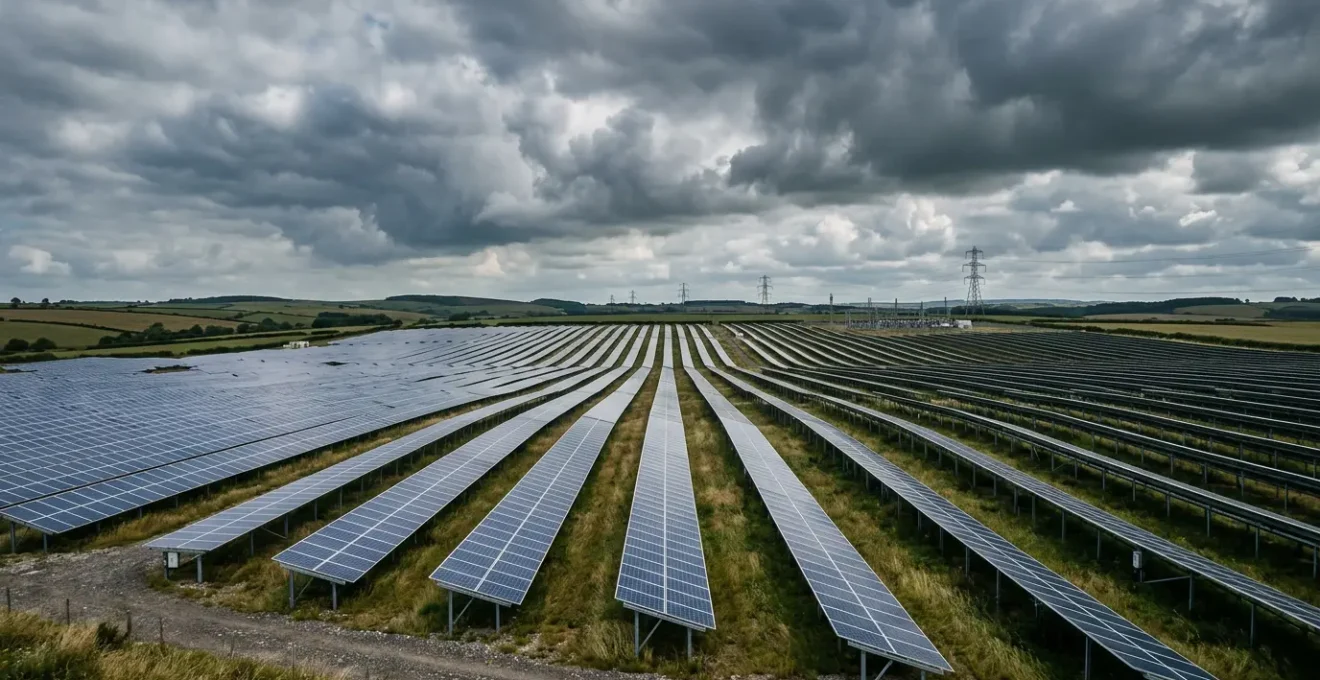
You’ve navigated the complexities of planning, financing, and construction. Your UK solar farm is operational, a testament to modern engineering ready to generate clean energy and revenue. Then, an instruction arrives from the National Grid ESO: curtail your output. The grid cannot handle the capacity. Your inverters are ramped down, megawatts of potential generation vanish, and your revenue stream is severed, not by a storm or a fire, but by a simple command. You check your business interruption (BI) policy, assuming you’re covered. The reality is a shock: you are not.
The standard insurance framework, built for an era of physical perils, is fundamentally misaligned with the primary operational risks facing modern renewable energy assets. While operators rightly focus on insuring against hail damage to panels or transformer failures, the most significant and growing threat to revenue is often non-damage business interruption. Grid curtailment is the prime example of this protection gap, where a perfectly functional asset is prevented from earning revenue due to external factors, leaving standard insurance policies silent and ineffective.
But what if the true failure isn’t in your operations, but in your understanding of the insurance you hold? The key is not to accept this lost revenue as an unavoidable cost of business, but to fundamentally rethink the insurance mechanism itself. This requires moving beyond policies that only respond to physical damage and embracing solutions engineered for the digital and operational risks of today’s energy market.
This analysis will deconstruct why your standard BI policy is unfit for purpose in a curtailment scenario. We will examine the critical need for precise documentation in component-level claims, the key transition points in a project’s insurance lifecycle, and ultimately, demonstrate how to calculate and secure the right level of revenue protection that actually responds when you need it most.
Summary: How to Insure a UK Solar Farm Against Revenue Loss from Grid Curtailment?
- Why Doesn’t Standard BI Cover Revenue Loss When the Grid Operator Curtails Your Output?
- How to Ensure Your Wind Turbine Gearbox Failure Is Covered Without Disputes?
- CAR to Operational: When Does Your Energy Project Insurance Need to Transition?
- The £2M Decommissioning Bond Gap That Blocked Your Mining Permit Renewal
- When Should You Update Energy Asset Insurance: At PPA Renewal or Grid Upgrade?
- Does Your BI Policy Require Physical Damage or Does It Cover Supply Chain Disruption?
- Why Does Your £50,000 Excess Feel Like £150,000 When Cash Flow Is Tight?
- How to Calculate the Right Level of Business Interruption Cover for Your Company?
Why Doesn’t Standard BI Cover Revenue Loss When the Grid Operator Curtails Your Output?
A standard Business Interruption (BI) policy fails to cover grid curtailment for one fundamental reason: it requires a physical damage trigger. Your policy is designed to respond to a loss of income that is a direct consequence of physical damage to your insured property, such as a fire, flood, or storm. When the National Grid instructs you to power down, your solar farm remains in perfect working order. There is no damage, so the primary condition for your BI policy to activate is not met. This is a critical distinction that leaves many renewable operators exposed.
The scale of this uninsured risk is vast; 10 TWh of renewable electricity was curtailed in Great Britain in 2025 alone, a figure that continues to rise as more generation comes online ahead of grid capacity upgrades. Operators receive constraint payments, but as the industry body RenewableUK notes, these are not a substitute for operational revenue. According to RenewableUK’s analysis, « Constraint payments are not a source of additional income for wind farm developers, but rather a form of compensation for lost marginal revenue. »

Furthermore, even if you could argue an interruption occurred, your claim would likely be defeated by specific exclusion clauses. Standard policies almost universally contain exclusions for losses arising from ‘orders of a civil authority’ or ‘public grid failure’. The instruction from the grid operator is precisely such an order, making it an explicitly excluded event. This contractual reality means that relying on a standard BI policy for curtailment risk is not just optimistic; it is a guaranteed path to a denied claim.
How to Ensure Your Wind Turbine Gearbox Failure Is Covered Without Disputes?
To ensure a wind turbine gearbox failure is covered without dispute, you must provide indisputable evidence that the event was sudden and unforeseen, rather than the result of gradual deterioration or wear and tear, which are standard exclusions. Insurers operate on the principle of fortuity; they cover accidental damage, not inevitable decay. The burden of proof falls on the operator to demonstrate that a specific event occurred, not just that a component reached the end of its predictable life.
This is a crucial point of contention in claims. As Nathan Davies of Lloyd Warwick highlighted, the dynamic shifts once a policy is operational: « To trigger an operational policy, there needs to be proof of damage. It’s now on insurers to prove that whatever has caused that damage is an exclusion—that might be wear and tear, gradual deterioration, or poor workmanship. » Your role is to leave them with no room to apply those exclusions. This requires a forensic level of documentation that pre-emptively counters any suggestion of negligence or poor maintenance.
The evidence required goes far beyond a simple work order for a replacement. Insurers will demand a comprehensive data package to validate the claim, proving the failure was an insurable event and not an operational maintenance issue you are trying to pass on. Proving proactive management is key.
Your Action Plan: Critical Documentation for Gearbox Failure Claims
- SCADA Data: Provide operational data showing parameters like torque, temperature, and vibration in the period leading up to the failure to prove it was operating within designated limits.
- Oil Analysis History: Submit a complete history of regular oil sampling and trend analysis to demonstrate you were monitoring the health of the component and not ignoring signs of degradation.
- Full Maintenance Logs: Present timestamped logs of all inspections, servicing, and interventions, proving you adhered to (or exceeded) the manufacturer’s recommended maintenance schedule.
- End-of-Warranty Reports: Supply the end-of-warranty inspection reports which establish the baseline condition of the gearbox at the point of handover from the contractor.
- CMS Data: If available, data from a Condition Monitoring System is your strongest evidence, proving you were actively monitoring for anomalies and not willfully ignorant of a developing issue.
CAR to Operational: When Does Your Energy Project Insurance Need to Transition?
The transition from a Construction All Risks (CAR) policy to an Operational policy is one of the most critical and risk-laden moments in an energy project’s lifecycle. This transition typically occurs at the point of Provisional Acceptance or Substantial Completion, often marked by the project’s ability to export power to the grid for the first time. Mismanaging this handover can create significant coverage gaps, particularly for defects that are not immediately apparent.
A CAR policy is designed to cover physical damage during the construction phase. An Operational policy covers physical damage and resulting business interruption once the asset is running. The crucial gap lies in defects in design, workmanship, or materials that were present during construction but only manifest themselves months or even years into the operational phase. A standard operational policy may exclude these so-called « built-in defects », arguing they are not a fortuitous event but a pre-existing condition.
This is where specialised extensions and policies become vital. As reinsurance giant Munich Re states in their guidance on wind park insurance, « Built-in defects are often discovered only in the operational phase. The EPC Cover insures a wide range of contractual risks, providing substantial safeguard in the event of a large warranty claim as well as serial losses due to faulty construction, for a period of up to five years. » This highlights the need for cover that bridges the gap between the EPC contractor’s liability and the operational policy’s triggers.
Effectively, the project needs a seamless insurance wrap that extends beyond the simple CAR-to-Operational switch. This could involve LEG 2/3 (Latent Defects) extensions, specific Defective Design/Workmanship clauses, or a dedicated EPC « wrap-up » policy that provides long-term protection against serial defects. Without this, an operator could face a catastrophic failure of multiple components, only to find the contractor is out of business and the operational insurer is pointing to a « pre-existing condition » exclusion.
The £2M Decommissioning Bond Gap That Blocked Your Mining Permit Renewal
For resource extraction operators, the risk of a blocked permit renewal due to an inadequate decommissioning bond is a ticking financial time bomb. Imagine a UK-based quarry operator whose original permit, granted 15 years ago, required a £3 million decommissioning and site restoration bond. This was secured through a standard bank guarantee, tying up a significant portion of the company’s credit line. Now, as the permit comes up for renewal, the environmental regulator conducts a new assessment. Due to higher inflation, stricter environmental standards, and changes in disposal regulations, the true estimated cost of decommissioning has ballooned to £5 million.
The regulator issues a stark ultimatum: post an additional £2 million in financial security, or the permit renewal will be denied, effectively halting all operations. The operator is now in a crisis. Their bank is unwilling to extend the guarantee by another £2 million without substantial new collateral, which would cripple the company’s cash flow and ability to invest. The business is solvent and profitable, but its future is held hostage by a decommissioning bond gap that it cannot easily fill with traditional financial instruments.
This scenario highlights a critical risk for any long-term project with end-of-life obligations. Relying solely on bank guarantees or cash deposits for these bonds creates immense balance sheet inefficiency and exposure to regulatory reassessments. The modern solution lies in the surety and insurance market. A surety bond or a specialist decommissioning insurance policy can meet the regulator’s requirements without encumbering the operator’s working capital. These instruments are underwritten based on the operator’s financial health and technical ability to perform the work, rather than just cold, hard collateral. By replacing the bank guarantee with a surety bond, the operator can free up their credit lines, satisfy the regulator, and ensure the permit is renewed without jeopardizing the financial viability of the entire operation.
When Should You Update Energy Asset Insurance: At PPA Renewal or Grid Upgrade?
You should update your energy asset insurance at any contractual or physical juncture that materially alters your project’s Maximum Foreseeable Loss (MFL). This means the answer is both: a Power Purchase Agreement (PPA) renewal and a major grid upgrade are both critical triggers for a full insurance review. Treating insurance as a static, « set-and-forget » contract is a direct path to being dangerously underinsured.
A PPA renewal, for example, can dramatically change your revenue profile. If you are moving from a fixed-price PPA to a merchant risk model, your exposure to price volatility skyrockets. Your BI cover, previously based on a predictable tariff, is now completely inadequate to cover potential losses calculated against fluctuating market prices. Conversely, a new long-term PPA at a higher price increases the value of every megawatt-hour you generate, meaning your existing BI sum insured may no longer cover the potential loss from a major outage.

Similarly, a grid upgrade (or lack thereof) is a huge factor. As more renewable assets connect, grid constraints worsen, increasing the frequency and duration of curtailment events. For instance, Montel’s curtailment analysis revealed that in 2025, only 61% of the potential wind energy in Northern Scotland made it to the grid. If your asset is in such a constrained area, your revenue risk from curtailment is far higher than for an asset in a less congested region, a fact that must be reflected in any specialist non-damage BI or parametric cover you seek. Your risk profile is not static; it is a dynamic function of your contracts, the physical grid around you, and market conditions.
Does Your BI Policy Require Physical Damage or Does It Cover Supply Chain Disruption?
Your standard Business Interruption (BI) policy almost certainly requires physical damage to your own insured assets as the trigger for coverage. It is not designed to respond to external events in your supply chain or, more critically for renewable operators, disruptions in the « off-take » chain—the ability to get your product (electricity) to market.
The conventional insurance mindset is clearly articulated in typical policy summaries. For example, GreenMatch UK explains that solar panel insurance may provide « coverage for the loss of income in the event of a power generation outage caused by covered perils. » Those « covered perils » are overwhelmingly physical: fire, hail, storms. This leaves a gaping hole for any revenue loss that occurs without a physical trigger at your site, such as grid curtailment.
The financial impact of this non-damage risk is significant and growing. While operators focus on insuring their panels, the real threat can be the grid’s inability to accept their power. The problem is escalating; an edie analysis shows that UK solar curtailment volume increased fourfold year-on-year in 2025. This is a massive, and for most, uninsured revenue loss. Your policy is looking for a broken panel, but the problem is a congested motorway. The insurance is looking at the wrong part of the system.
While some BI policies can be extended with « contingent business interruption » (CBI) clauses to cover disruptions at a key supplier or customer, these are notoriously difficult to claim on for grid issues. The grid is typically not named as a dependent property, and the « civil authority » exclusions often still apply. True protection from this risk requires moving away from damage-centric thinking and toward policies that directly insure revenue streams against specific, non-damage events.
Why Does Your £50,000 Excess Feel Like £150,000 When Cash Flow Is Tight?
A £50,000 policy excess feels like £150,000 during a major claim because the excess is merely the first, most visible cost in a cascade of uninsured expenses and cash flow drains. The « excess » (or deductible) is simply the portion of the physical repair cost that you bear. It does not account for the significant ancillary costs and the brutal impact of delayed revenue, which can turn a manageable figure into a corporate crisis, especially when cash flow is already tight.
When a major event occurs, the £50,000 excess is just the entry ticket. You must then fund the immediate costs of mitigation, site safety, and initial investigation. Crucially, you will need to hire your own experts—loss adjusters, engineers, forensic accountants—to build your claim and negotiate with the insurer’s team. These professional fees are rarely covered by the policy and can easily add another £50,000 to £100,000 to your out-of-pocket expenses before you see a single pound from the insurer.
This is compounded by the time lag. While you are funding these upfront costs, your revenue has stopped, but your fixed costs (debt service, salaries, land lease) have not. The insurer’s settlement for business interruption, which can take months or even years to arrive, further strains your working capital. This financial pressure is magnified by the frustration of the situation, especially in cases like grid constraints where, as RenewableUK explains, operators are « paying for a service they no longer receive and are thus entitled to compensation. » While constraint payments exist, the entire system contributes to a wider economic drag; regulatory analysis shows that constraint costs added around £15 to a typical annual household energy bill in late 2025.
Key Takeaways
- Standard Business Interruption (BI) policies are void for grid curtailment due to the required ‘physical damage’ trigger and specific ‘civil authority’ exclusions.
- Parametric insurance offers a direct, effective solution by using data triggers (e.g., hours of curtailment) to initiate fast, predictable payouts without needing to prove damage.
- Meticulous documentation (SCADA data, oil analysis, maintenance logs) is non-negotiable for successfully claiming on specific component failures like wind turbine gearboxes.
How to Calculate the Right Level of Business Interruption Cover for Your Company?
Calculating the right level of Business Interruption (BI) cover requires moving beyond simplistic Gross Profit calculations and adopting a model that truly reflects your specific revenue risks, especially non-damage events like curtailment. The traditional method—calculating gross profit over a 12 or 24-month indemnity period—is inadequate for a renewable energy asset whose primary risks are not physical. For a solar farm, the more relevant calculation is Maximum Foreseeable Loss (MFL) based on a portfolio of specific, non-damage perils.
This means identifying your key revenue vulnerabilities. Is it grid curtailment? Price volatility on the merchant market? A failure of a key supplier for a niche component? For each risk, you must model a realistic worst-case scenario. For curtailment, this involves analysing grid data for your region, forecasting constraint frequency, and calculating the lost revenue based on your PPA or expected merchant price. This data-driven approach leads directly to the most effective solution: parametric insurance.
The table below starkly contrasts the inadequacy of traditional BI with the precision of a parametric solution for a risk like grid curtailment.
| Criterion | Traditional Business Interruption | Parametric Insurance |
|---|---|---|
| Coverage Trigger | Physical damage to insured property required | Predefined index (e.g., curtailment hours, grid constraint events) |
| Grid Curtailment Coverage | Excluded – ‘orders of civil authority’ / ‘public grid failure’ clauses | Covered if trigger threshold met (e.g., >5% monthly output reduction) |
| Claim Settlement Time | Weeks to months (damage assessment, proof of loss) | Days (15-day average payout post-trigger) |
| Revenue Calculation Basis | Gross profit / historical earnings | Agreed sum linked to MWh curtailment or constraint payment data |
| Suitability for Merchant Risk | Poor – struggles with price volatility, no physical damage | Excellent – can link to forward curves, constraint frequency |
| Premium Structure | Based on asset value, complex underwriting | Based on trigger probability, often lower for defined risks |
Parametric insurance fundamentally changes the claim dynamic from a subjective, lengthy negotiation to an objective, automated process. As a study from Mordor Intelligence notes, « Parametric insurance uses predefined triggers—such as wind speed thresholds or solar irradiance levels—to automate payouts. This speed and transparency are transformative, reducing claim settlement times from weeks to days, with payouts often arriving within 15 days of a triggering event. » This speed is critical for managing cash flow during a disruption.
Protecting your revenue requires moving beyond traditional asset insurance that is blind to operational realities. The next step is to engage a specialist broker to model your specific curtailment risk and structure a parametric or hybrid policy that truly aligns with your revenue model and protects your bottom line from non-damage interruptions.